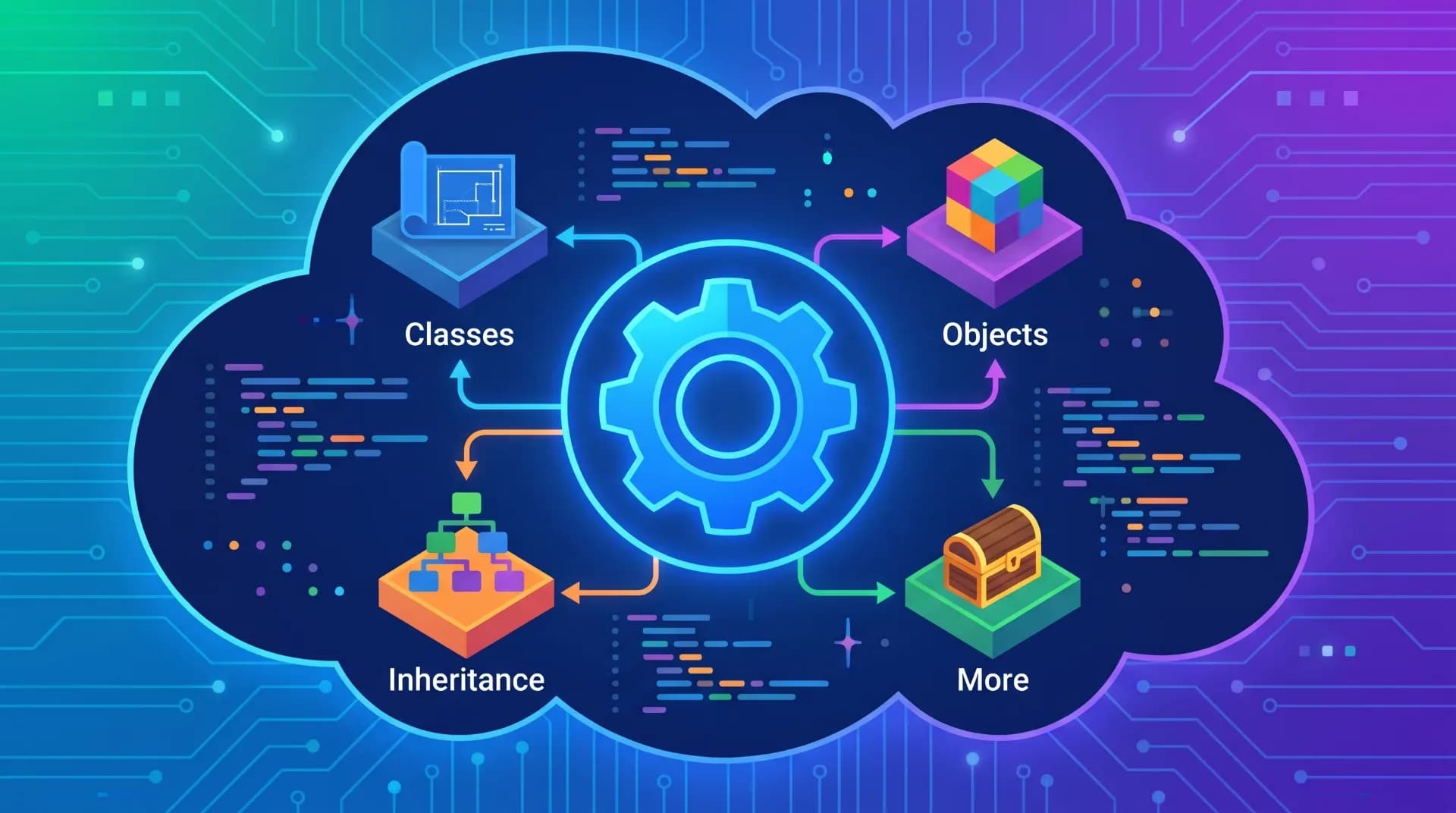
What Is Object-Oriented Programming?
Object-Oriented Programming (OOP) is a programming paradigm that organizes software around objects. An object is an encapsulation of data (its attributes) and the operations that work on that data (its methods).
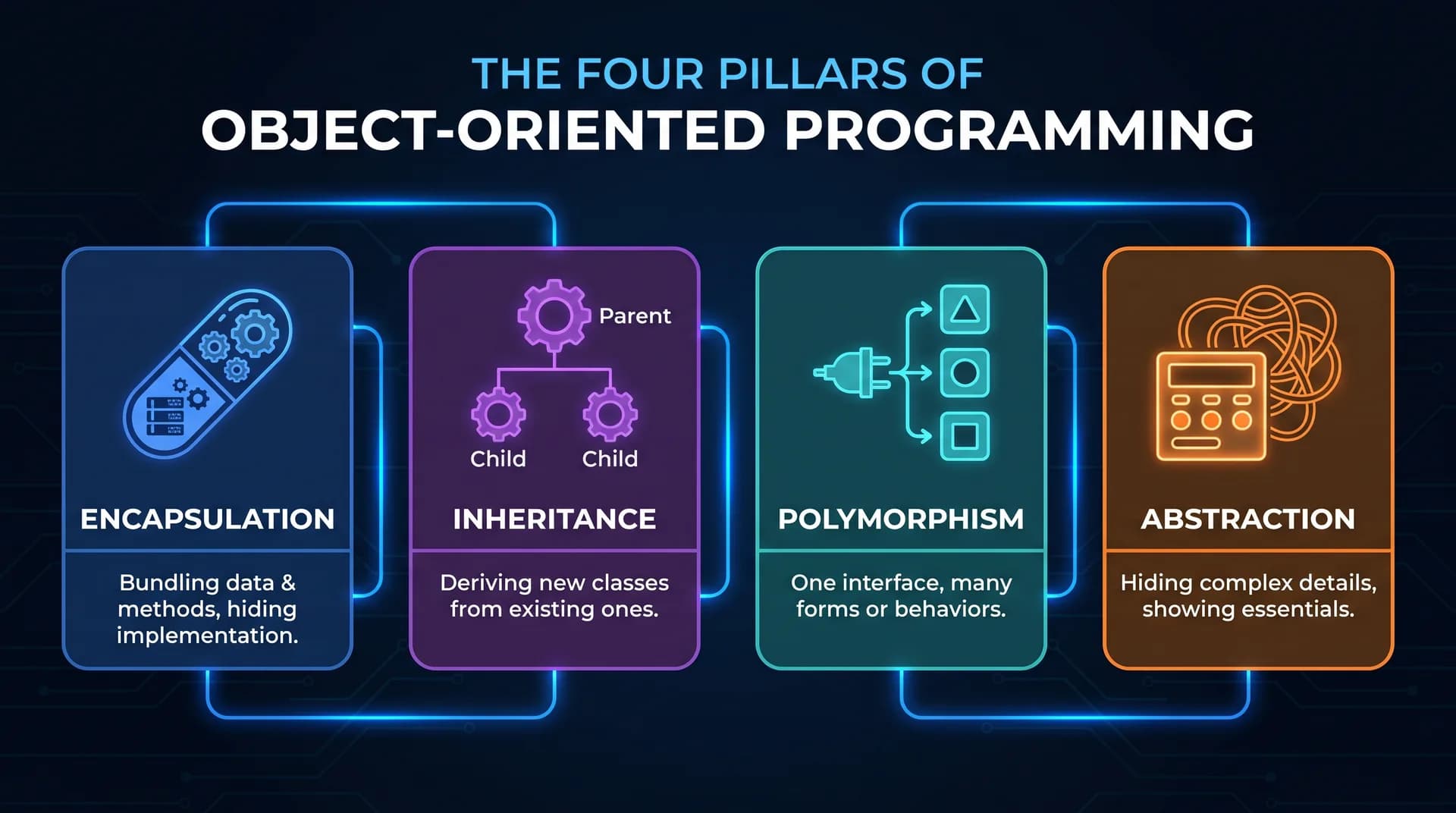
OOP uses classes as blueprints for objects. It helps build modular, reusable, and easier-to-maintain software.
For instance, a University Management System could use objects to represent students, lecturers, courses, and examinations. Each object would contain the data for a particular entity and the operations it can perform.
The four fundamental principles of OOP are:
- Encapsulation
- Inheritance
- Polymorphism
- Abstraction
Understanding these principles is absolutely fundamental if you're going to learn any of the languages out there (Python, Java, C++, C#, etc.).
Why is Object-Oriented Programming important?
Imagine building a university management system from tens of thousands of lines of code.
The system has to handle students, staff (lecturers), courses, assignments, grades, and attendance.
Without the right structure, the code can quickly become hard to understand and maintain. Changing one thing can inadvertently affect something else.
OOP addresses this problem by packaging related information and functionality into individual classes and objects.
Real-world example: University management system
A university system could contain the following classes:
| Class | Attributes (Data) | Methods (Behavior) |
|---|---|---|
| Student | Name, student ID, degree | Register, submit assignment |
| Lecturer | Name, employee ID | Teach, evaluate |
| Course | Course code, course name | Enroll student |
| Examination | Exam date, subject | Schedule, evaluate |
Each class represents a particular entity in the system.
Developers can create multiple instances of an object from a single class, thus eliminating the need to write the same code over and over again.
Key benefits of OOP
- Code reusability: Existing classes can be reused or extended.
- Modularity: Programs are divided into manageable components.
- Maintainability: You can change individual components.
- Scalability: You can introduce new features using existing structures.
- Data protection: Encapsulation helps control how data is accessed and modified.
OOP is particularly useful for large applications, enterprise software, game development, and any system that models a complex set of entities.
Understanding Classes and Objects
Classes and objects are the basis of object-oriented programming.
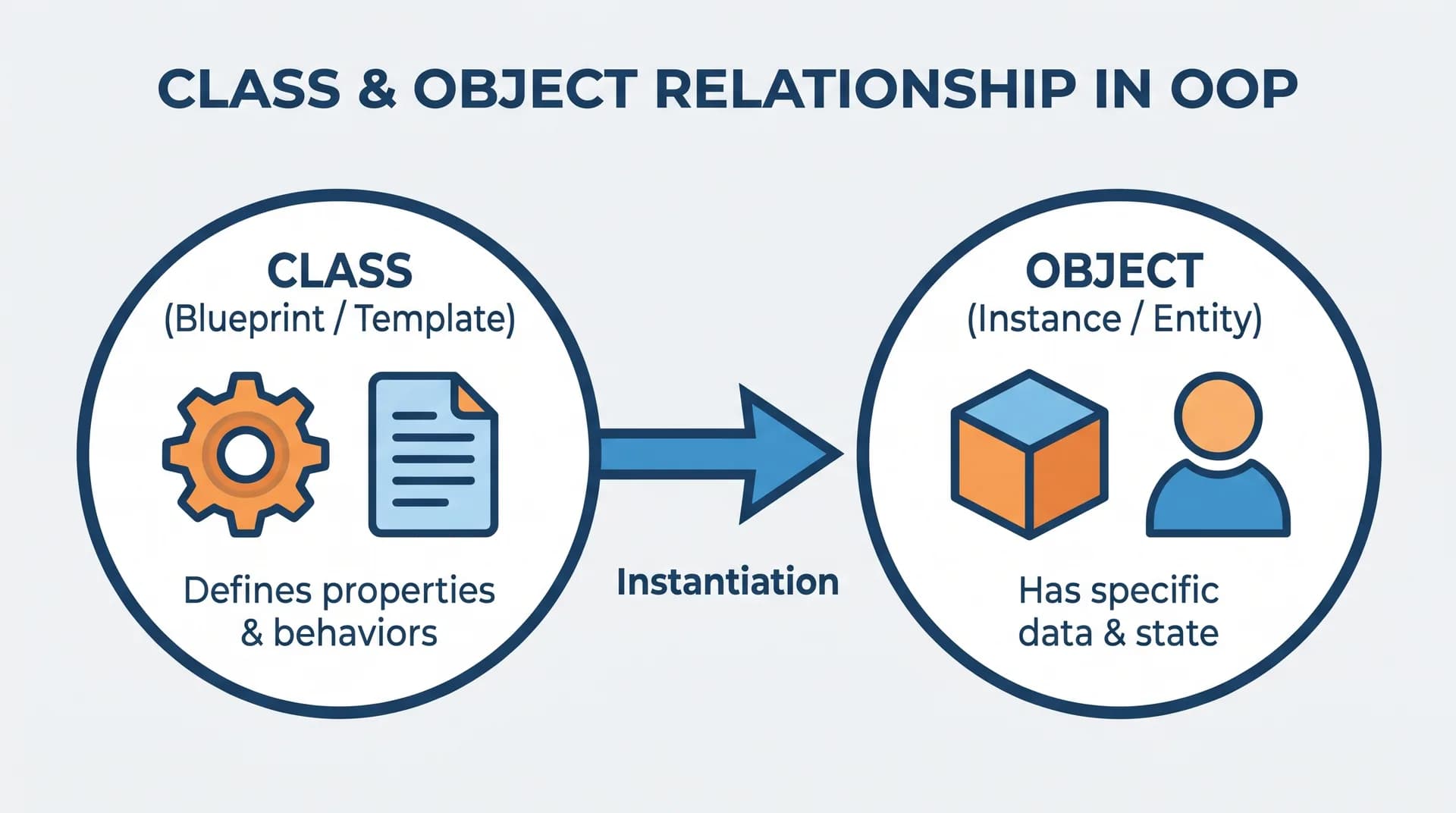
To understand them, consider a university library.
A library could contain thousands of books. Each book has attributes (e.g., title, author, ISBN), but each book has values.
A class defines the common structure, and each object is an individual book.
What Is a Class?
A class is a blueprint/template to create objects.
It defines the properties and methods that an object of that class can have.
For example, a Book class might define:
- Title
- Author
- ISBN
- Availability status
It may also define methods such as:
- Borrow a book
- Return a book
- Display book details
Here is a simple Python example:
class Book:
    def __init__(self, title, author):
        self.title = title
        self.author = author

    def display_info(self):
        print(self.title, "by", self.author)
Let's understand the code.
- class Book: defines a class named Book.
- init() is the initializer that runs when an object is created.
- self refers to the current instance.
- self. title and self. author store the object's attributes.
- display_info() is a method that displays information about the book.
A class doesn't need to contain all the possible features of an entity. It only needs to define the structure and behavior that the application requires.
What Is an Object?
An object is an instance of a class.
When a program creates an object from a class, it creates a specific instance with its own data.
For example:
book1 = Book("Python Basics", "John Smith")
book2 = Book("Java Programming", "Jane Wilson")
book1.display_info()
book2.display_info()
Output:
Python Basics by John Smith
Java Programming by Jane Wilson
Both items use the same Book class.
However, they do have different attribute values.
This demonstrates an important concept:
One class can create many objects, and each object can have its own state.
Class vs. Object
| Class | Object |
|---|---|
| A blueprint or template | An instance of a class |
| Defines attributes and methods | Contains actual attribute values |
| Defines a structure | Represents a specific entity |
Example: Book | Example: book1 |
Think of a class as a house blueprint and an object as the actual house that you build from that blueprint.
The plan is the blueprint. The actual houses can be different colors, have all sorts of furniture, and be owned by all sorts of people.
The Four Pillars of Object-Oriented Programming
The four pillars of OOP are encapsulation, inheritance, polymorphism, and abstraction.
These principles help developers structure software, manage complexity, and create flexible applications.
1. Encapsulation
Encapsulation combines data and the methods that operate on it into a single unit (usually a class).
It also involves controlling access to an object's internal state.
Consider a bank account.
A bank account has a balance. Users should not be able to set the balance to any value they like.
Instead, the account provides methods such as deposit() and withdraw().
Example:
class BankAccount:
    def __init__(self, balance):
        self.__balance = balance

    def deposit(self, amount):
        if amount > 0:
            self.__balance += amount

    def get_balance(self):
        return self.__balance
Usage:
account = BankAccount(1000)
account.deposit(500)
print(account.get_balance())  # Output: 1500
Here, __balance uses Python's name-mangling convention to discourage direct access.
Python doesn't have the strict private attributes that you find in some other languages. That said, it's a useful way to illustrate encapsulation.
Why is encapsulation useful?
- Helps protect data from accidental modification.
- Allows validation before changing data.
- Keeps related behavior and data together.
- Makes software easier to maintain.
For instance, a banking app can validate the withdrawal amount before changing the balance.
2. Inheritance
Inheritance enables a class to inherit the attributes and methods of another class.
The original class is generally referred to as the parent class or the superclass.
The new class is called the child class or subclass.
Inheritance supports code reuse and lets you create specialized versions of existing classes.
Consider a university system.
Both students and lecturers are people. They all have a name and an age, but they have different roles.
Example:
class Person:
    def __init__(self, name, age):
        self.name = name
        self.age = age

    def introduce(self):
        print("My name is", self.name)

class Student(Person):
    def __init__(self, name, age, student_id):
        super().__init__(name, age)
        self.student_id = student_id

student = Student("Alex", 20, "IT2026001")
student.introduce()
print(student.student_id)
Output:
My name is Alex
IT2026001
The Student class inherits from Person.
The super() function calls the parent class initializer, allowing the child class to reuse the parent's initialization logic.
The student object receives the attributes and methods defined in Person, while also having its own student_id attribute.
Types of Inheritance
Different programming languages support different inheritance structures.
| Inheritance Type | Structure & Description |
|---|---|
| Single inheritance | One child class inherits from one parent class |
| Multiple inheritance | One child class inherits from multiple parent classes |
| Multilevel inheritance | A class inherits from a class that itself inherits from another class |
| Hierarchical inheritance | Multiple child classes inherit from the same parent class |
| Hybrid inheritance | A combination of multiple inheritance structures |
For example:
     Person
       |
    Student
       |
  Undergraduate
This is an example of multilevel inheritance.
Inheritance is useful when classes have common behavior. You shouldn't use it to avoid writing a few lines of code, though. Poorly structured inheritance can make software harder to understand.
3. Polymorphism
Polymorphism means "many forms."
In OOP, polymorphism enables different objects to respond to the same method or interface in different ways.
For instance, different animals can make different sounds.
A dog barks; a cat meows.
Both objects can have a make_sound() method; the implementation is just different.
Example:
class Dog:
    def make_sound(self):
        print("Bark")

class Cat:
    def make_sound(self):
        print("Meow")

animals = [Dog(), Cat()]
for animal in animals:
    animal.make_sound()
Output:
Bark
Meow
The same method call produces different results depending on the object.
This is an example of polymorphism.
Why Is Polymorphism Useful?
Imagine a game containing different types of characters:
- Warriors
- Wizards
- Archers
Each character can have an attack() method.
The program can call attack() on each character, without needing to know what kind of character it is.
This makes the app much easier to extend.
A new character type can implement the same behavior without major changes to the existing code.
4. Abstraction
Abstraction hides implementation details and exposes only the essential functionality.
Consider using an ATM.
When you're taking cash out, you don't need to know how the ATM talks to the bank's database, validates the transaction, or processes the request.
You need to interact with the available options.
This is an example of abstraction.
In Python, you achieve abstraction with abstract classes.
Example:
from abc import ABC, abstractmethod

class Payment(ABC):
    @abstractmethod
    def process_payment(self):
        pass

class CardPayment(Payment):
    def process_payment(self):
        print("Processing card payment")

class OnlinePayment(Payment):
    def process_payment(self):
        print("Processing online payment")
Here:
- Payment is an abstract class.
- process_payment() is an abstract method.
- CardPayment and OnlinePayment provide their own implementations.
The abstract class defines what the payment classes must do, without actually specifying how any of the payment methods work.
Abstraction vs. Encapsulation
These concepts are related, but they are not the same.
| Abstraction | Encapsulation |
|---|---|
| Hides implementation complexity | Bundles data and behavior |
| Focuses on what an object does | Focuses on how data and behavior are organized |
| Defines essential functionality | Controls access to internal state |
| Example: Payment interface | Example: Bank account balance |
Remember:
Abstraction hides complexity. Encapsulation organizes and protects internal state.
A Practical OOP Example in Python
Now let's combine the concepts into a small application.
Imagine developing a simple university course registration system.
The system needs to:
- Store student information.
- Allow students to enroll in courses.
- Display enrolled courses.
- Reuse common student functionality.
Here is a practical implementation:
class Student:
    def __init__(self, name, student_id):
        self.name = name
        self.student_id = student_id
        self.courses = []

    def enroll(self, course):
        if course not in self.courses:
            self.courses.append(course)

    def display_courses(self):
        print(f"Courses for {self.name}:")
        for course in self.courses:
            print(course)

class UndergraduateStudent(Student):
    def __init__(self, name, student_id, degree):
        super().__init__(name, student_id)
        self.degree = degree

student = UndergraduateStudent(
    "Alex",
    "IT2026001",
    "Information Technology"
)
student.enroll("Object-Oriented Programming")
student.enroll("Database Management Systems")
student.display_courses()
Output:
Courses for Alex:
Object-Oriented Programming
Database Management Systems
How Does This Example Demonstrate OOP?
| OOP Pillar | How It Is Applied |
|---|---|
| Class | Student and UndergraduateStudent |
| Object | student |
| Encapsulation | Student data and related methods are grouped together |
| Inheritance | UndergraduateStudent inherits from Student |
| Polymorphism | The inherited methods can be overridden by subclasses |
| Abstraction | The application exposes methods such as enroll() instead of requiring users to manipulate the course list directly |
One thing to note: this example shows encapsulation by grouping data and behavior, but it doesn't prevent you from modifying the courses list directly. A real-world application would likely include additional validation and controlled access.
This is how the OOP concepts work together in a real programming scenario.
Advantages and Disadvantages of OOP
OOP is a powerful paradigm, but it's not the right solution for every problem.
Advantages of OOP
- Code reusability
Inheritance and composition both enable the reuse of existing functionality.
- Better organization
Classes separate responsibilities, making complex applications much easier to understand.
- Easier maintenance
Developers can change individual parts without rewriting the whole application.
- Improved scalability
New features can be added via the existing classes and interfaces.
- Better modeling of real-world systems
OOP can represent entities such as customers, products, employees, and transactions.
Disadvantages of OOP
- Learning complexity
Beginners will need some time to get their heads around classes, objects, inheritance, and polymorphism.
- More code for simple tasks
A tiny program might not need any classes at all, or even multiple classes.
- Potentially complex inheritance
Deep inheritance hierarchies can make software very difficult to maintain.
- Poor design can create unnecessary dependencies
Heavily interdependent classes can make changes difficult.
Use OOP when it improves the app's structure, rather than forcing every problem into a class.
OOP vs. Procedural Programming
Procedural programming and Object-Oriented programming are the two main paradigms.
Procedural programming organizes the program around procedures or functions.
OOP organizes programs around objects, which encapsulate both data and behavior.
| Feature | Procedural Programming | Object-Oriented Programming (OOP) |
|---|---|---|
| Main structure | Functions and procedures | Classes and objects |
| Data organization | Often separate from functions | Bundled with methods |
| Code reuse | Functions | Inheritance, composition, methods |
| Data protection | Depends on language and design | Encapsulation mechanisms |
| Best suited for | Small scripts and straightforward tasks | Complex systems with related entities |
| Example languages | C, Pascal | Java, C++, Python |
Both approaches can build reliable software.
For example, Python supports both procedural programming and OOP. You can use functions for the simple stuff and classes when you start to need a more structured approach.
No universal rule says one paradigm is better than the other.
Common OOP Mistakes Beginners Should Avoid
Understanding OOP definitions is fine, but applying them correctly matters more.
Here are some common mistakes beginners make.
1. Confusing classes and objects
A class is a blueprint. An object is an instance of that class.
For example:
class Car:
    pass

car1 = Car()
car2 = Car()
Car is the class, while car1 and car2 are separate objects.
2. Forgetting the self parameter
In Python, instance methods normally take the current instance as the first argument (self).
Incorrect:
# Incorrect (missing self parameter — raises TypeError when called on an instance)
class Student:
    def display():
        print("Student")
Correct:
# Correct (includes self parameter)
class Student:
    def display(self):
        print("Student")
When you call an instance method, Python will supply the instance automatically.
3. Using inheritance unnecessarily
Not every relationship needs to use inheritance.
For instance, a university student has a laptop; a student is not a laptop.
This is better represented via composition or as an attribute.
4. Confusing abstraction with encapsulation
Abstraction hides implementation details from a component's users.
Encapsulation groups data and behavior and can restrict access to internal state.
They work together, but they describe different ideas.
5. Creating too many classes
Classes should represent a meaningful responsibility.
Creating a separate class for every small operation will make the program far too complex.
A good OOP design balances structure and simplicity.
Frequently Asked Questions About Object-Oriented Programming
1. What is Object-Oriented Programming in simple terms?
Object-Oriented Programming is a way of writing programs using objects. An object contains data and methods that operate on that data. OOP structures your code into discrete, reusable, and manageable components.
2. What are the four pillars of OOP?
The four pillars of OOP are:
- Encapsulation: bundling data and methods together and controlling access to the internal state.
- Inheritance: Creating new classes based on existing classes.
- Polymorphism: Allowing different objects to respond to the same method in different ways.
- Abstraction: Hiding implementation details and exposing essential functionality.
3. What is the difference between a class and an object?
A class is a blueprint that defines an object's structure and behavior. An object is an instance of that class.
For example, Car is a class, and a particular Toyota or Honda instantiated from that class is an object.
4. What is inheritance in OOP?
Inheritance enables a child class to inherit the attributes and methods of a parent class.
For instance, a Student class could inherit the common attributes of name and age from a Person class.
Inheritance promotes code reuse and enables you to create specialized classes.
5. What is polymorphism in programming?
Polymorphism lets different objects share the same method name/interface, with each object providing its own implementation.
For instance, a Dog and a Cat can both have a make_sound() method; the Dog barks, and the Cat meows.
6. What is encapsulation in OOP?
Encapsulation is the process of wrapping data and the methods that operate on it within a class. It can also control how internal data is accessed and modified.
For example, a bank account can provide deposit and withdrawal methods instead of allowing the balance to change freely.
7. Is Python an object-oriented programming language?
Yes. Python supports OOP (Object-Oriented Programming) with all the standard features: classes, objects, inheritance, encapsulation, and polymorphism.
Python also supports procedural and functional programming, so it's a multi-paradigm language.
8. What are the benefits of Object-Oriented Programming?
The primary benefits are code reusability, modularity, maintainability, scalability, and better organization.
OOP is particularly useful when you're building large applications with lots of interrelated parts.
9. What's the difference between abstraction and encapsulation?
Abstraction hides unnecessary implementation details and exposes only the essential functionality.
Encapsulation groups data and behavior together and controls access to the internal state.
For instance, an ATM interface is an example of abstraction, and a bank account's internal balance management is an example of encapsulation.
10. What programming languages support OOP?
Popular object-oriented programming languages include:
- Java
- Python
- C++
- C#
- Ruby
- Kotlin
- Swift
JavaScript also supports OOP via its prototype-based object model and class syntax.
Conclusion
Object-oriented programming is one of the most important concepts in modern-day software development.
By getting to grips with classes, objects, inheritance, encapsulation, polymorphism, and abstraction, you can create software that is much easier to structure, reuse, and maintain.
The key concepts to remember are:
- A class defines an object's structure.
- An object is an instance of a class.
- Encapsulation combines data and behavior while helping control access to internal state.
- Inheritance allows classes to reuse and extend existing functionality.
- Polymorphism allows different objects to respond to the same interface in different ways.
- Abstraction hides unnecessary implementation details.
OOP becomes much easier when you practice building small applications instead of memorizing definitions.
Start with a Student class, create a few objects, and gradually introduce inheritance and polymorphism. Once you understand these concepts, you will be better prepared to design larger applications using Python, Java, C++, or other object-oriented languages.
Test Your Object-Oriented Programming Mastery
Apply OOP concepts across both Java and Python foundations with these interactive quizzes: