
Introduction to Pattern Programming
Java Star Patterns: A Beginner’s Guide to Pattern Programming is a great way to develop logical thinking through learning Java. Making patterns of stars on screen may sound simple. But every pattern teaches us some important programming concepts, loops, nested loops, conditions or designing an algorithm.
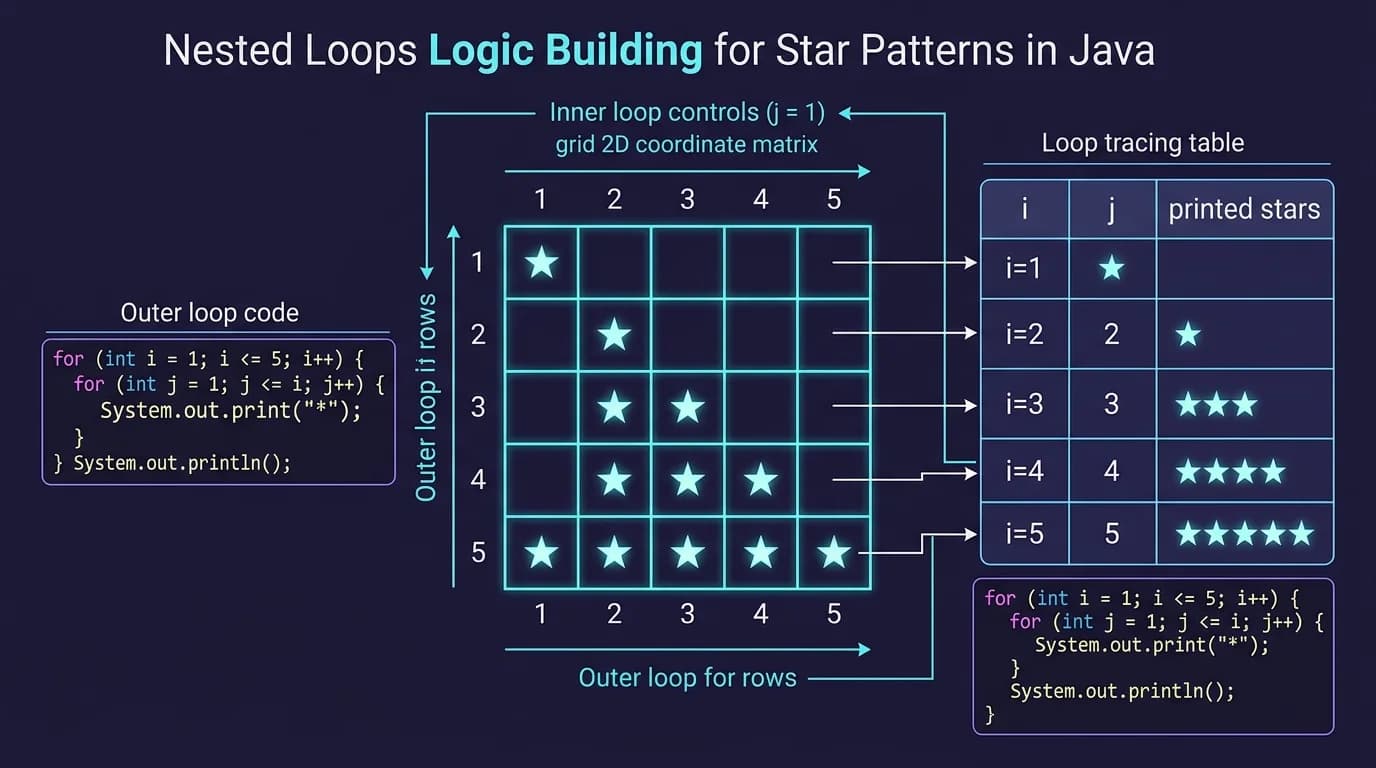
Most computer programmers usually use pattern programming in Coding Interviews, Assignments, and Coding Competitions. Moreover, this has a simple pattern making.
Why Every Java Beginner Should Learn Star Patterns
Many new programmers focus only on syntax. However, syntax alone does not improve logical reasoning.
Learning star patterns helps you:
- Improve analytical thinking
- Understand nested loops
- Learn iteration effectively
- Build confidence with Java programming
- Prepare for technical interviews
Every pattern introduces a new way of thinking about rows, columns, and conditions.
Prerequisites for Learning Java Star Patterns
Before starting, you should understand:
| Concept | Importance |
| Variables | Store values |
| Data Types | Define information |
| for Loops | Repeat operations |
| if Statements | Control execution |
| System.out.print() | Display output |
Once these concepts are clear, pattern programming becomes much easier.
Understanding Loops in Java
Loops repeat instructions multiple times.
The for Loop
Basic syntax:
for(int i = 1; i <= 5; i++){
    System.out.println(i);
}
This loop prints numbers from 1 to 5.
Nested Loops Explained
Star patterns almost always use nested loops.
Example:
for(int row = 1; row <= 3; row++){
    for(int col = 1; col <= 3; col++){
        System.out.print("*");
    }
    System.out.println();
}
Output:
***
***
***
The outer loop controls rows while the inner loop controls columns.
Basic Java Star Patterns
1. Square Pattern
Code:
for(int i=1;i<=5;i++){
    for(int j=1;j<=5;j++){
        System.out.print("* ");
    }
    System.out.println();
}
Output:
* * * * *
* * * * *
* * * * *
* * * * *
* * * * *
2. Rectangle Pattern
for(int i=1;i<=4;i++){
    for(int j=1;j<=6;j++){
        System.out.print("* ");
    }
    System.out.println();
}
Output:
* * * * * *
* * * * * *
* * * * * *
* * * * * *
3. Right Triangle Pattern
for(int i=1;i<=5;i++){
    for(int j=1;j<=i;j++){
        System.out.print("* ");
    }
    System.out.println();
}
Output:
*
* *
* * *
* * * *
* * * * *
4. Inverted Right Triangle
for(int i=5;i>=1;i--){
    for(int j=1;j<=i;j++){
        System.out.print("* ");
    }
    System.out.println();
}
Output:
* * * * *
* * * *
* * *
* *
*
Intermediate Java Star Patterns
5. Pyramid Pattern
for(int i=1;i<=5;i++){

    for(int s=1;s<=5-i;s++)
        System.out.print(" ");

    for(int j=1;j<=2*i-1;j++)
        System.out.print("*");

    System.out.println();
}
Output:
    *
   ***
  *****
 *******
*********
This pattern combines spaces and stars, making it excellent practice for nested loops.
6. Inverted Pyramid
for(int i=5;i>=1;i--){

    for(int s=1;s<=5-i;s++)
        System.out.print(" ");

    for(int j=1;j<=2*i-1;j++)
        System.out.print("*");

    System.out.println();
}
Output:
*********
 *******
  *****
   ***
    *
7. Diamond Pattern
A diamond combines a pyramid and an inverted pyramid.
Upper half:
for(int i=1;i<=5;i++){

    for(int s=1;s<=5-i;s++)
        System.out.print(" ");

    for(int j=1;j<=2*i-1;j++)
        System.out.print("*");

    System.out.println();
}
Lower half:
for(int i=4;i>=1;i--){

    for(int s=1;s<=5-i;s++)
        System.out.print(" ");

    for(int j=1;j<=2*i-1;j++)
        System.out.print("*");

    System.out.println();
}
Output:
    *
   ***
  *****
 *******
*********
 *******
  *****
   ***
    *
Number and Character Pattern Concepts
Once you understand star patterns, you can easily create number and alphabet patterns.
Example number pattern:
1
12
123
1234
12345
Example character pattern:
A
AB
ABC
ABCD
ABCDE
The logic remains almost identical. Only the printed value changes.
Common Mistakes Beginners Make
Many learners struggle because they:
- Forget to reset inner loop variables
- Mix row and column conditions
- Print spaces incorrectly
- Use
println()instead ofprint() - Ignore indentation
The best solution is to draw the pattern on paper before writing code.
Tips for Mastering Pattern Programming
Follow these practical tips:
Think in Rows
Ask:
"How many rows are there?"
Count Columns
For each row determine:
"How many stars should appear?"
Identify Spaces
Complex patterns usually require leading spaces before stars.
Practice Daily
Even solving two patterns every day dramatically improves logical thinking.
Modify Existing Patterns
Try changing:
- Triangle to inverted triangle
- Pyramid to diamond
- Stars to numbers
- Numbers to letters
This exercise strengthens problem-solving skills.
Practice Exercises
Try implementing these on your own:
- Hollow Square
- Hollow Rectangle
- Hollow Pyramid
- Butterfly Pattern
- Sandglass Pattern
- Zigzag Star Pattern
- Pascal Triangle
- Floyd's Triangle
Attempting these without looking at solutions is an excellent way to improve.
Advantages of Learning Pattern Programming
Pattern programming offers several long-term benefits:
- Builds algorithmic thinking
- Improves debugging skills
- Makes nested loops easier to understand
- Increases coding confidence
- Helps prepare for technical interviews
- Creates a strong foundation for data structures and algorithms
Many experienced Java developers recommend mastering patterns before moving to advanced topics.
Resources for Continued Learning
For additional Java tutorials and official documentation, visit:
https://docs.oracle.com/javase/tutorial/
The official Java documentation provides reliable explanations, examples, and best practices for beginners and experienced developers alike.
Frequently Asked Questions
1. Why are Java star patterns important?
They improve logical thinking, strengthen loop concepts, and prepare beginners for algorithm-based programming.
2. Which Java concept is most important for star patterns?
Nested for loops are the foundation of almost every star pattern.
3. Are star patterns asked in coding interviews?
Yes. Many beginner and entry-level technical interviews include pattern programming questions to evaluate logical reasoning.
4. How long does it take to master pattern programming?
With consistent practice for 20–30 minutes a day, most beginners become comfortable within a few weeks.
5. Should I memorize every pattern?
No. Understanding the row-column relationship is much more valuable than memorizing code.
6. Can star pattern logic help with data structures and algorithms?
Absolutely. The ability to analyze loops, conditions, and iteration transfers directly to arrays, matrices, recursion, and many algorithmic problems.
Conclusion
Are you learning Java? And looking for a good point to start? An introductory article to pattern programming using Java star patterns for beginners. Creating star patterns may look like a simple task but they certainly help to enhance logical thinking, strengthen weighted concept of nested loops and sharpens problemsolving skills.
When you understand the patterns of squares, triangles, pyramids, and diamonds, you'll feel confident enough to easily write neat and clean codes. In other words, it will help you mix with the complex codes in Java. In other words, it will help you in immersing yourself in complex Java Programming.