Introduction
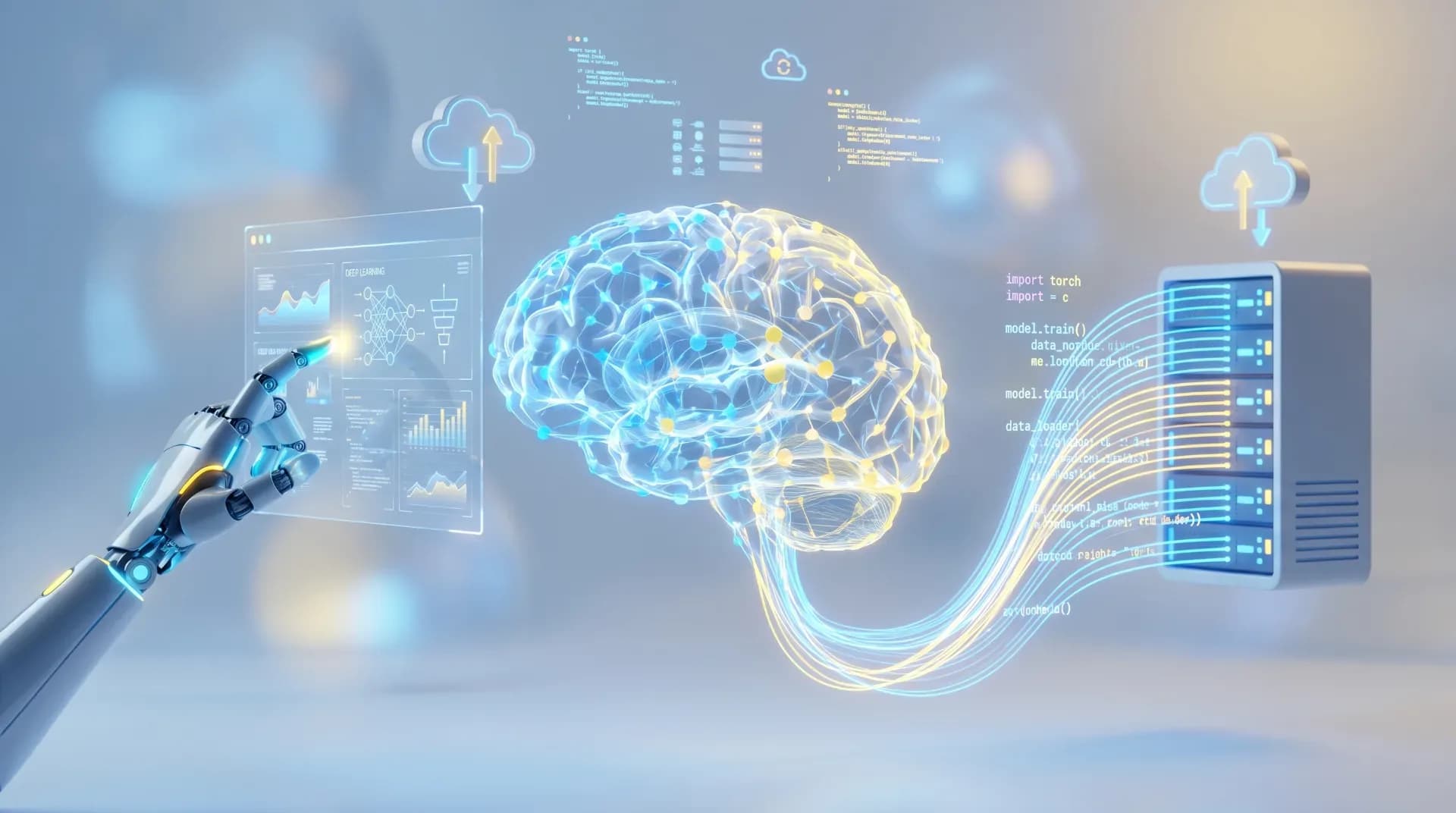
Python's significance in Artificial Intelligence and Machine Learning has grown over the past decade. As organizations and researchers adopt intelligent systems for automation, data analysis, and prediction, Python has become the preferred programming language for AI development.
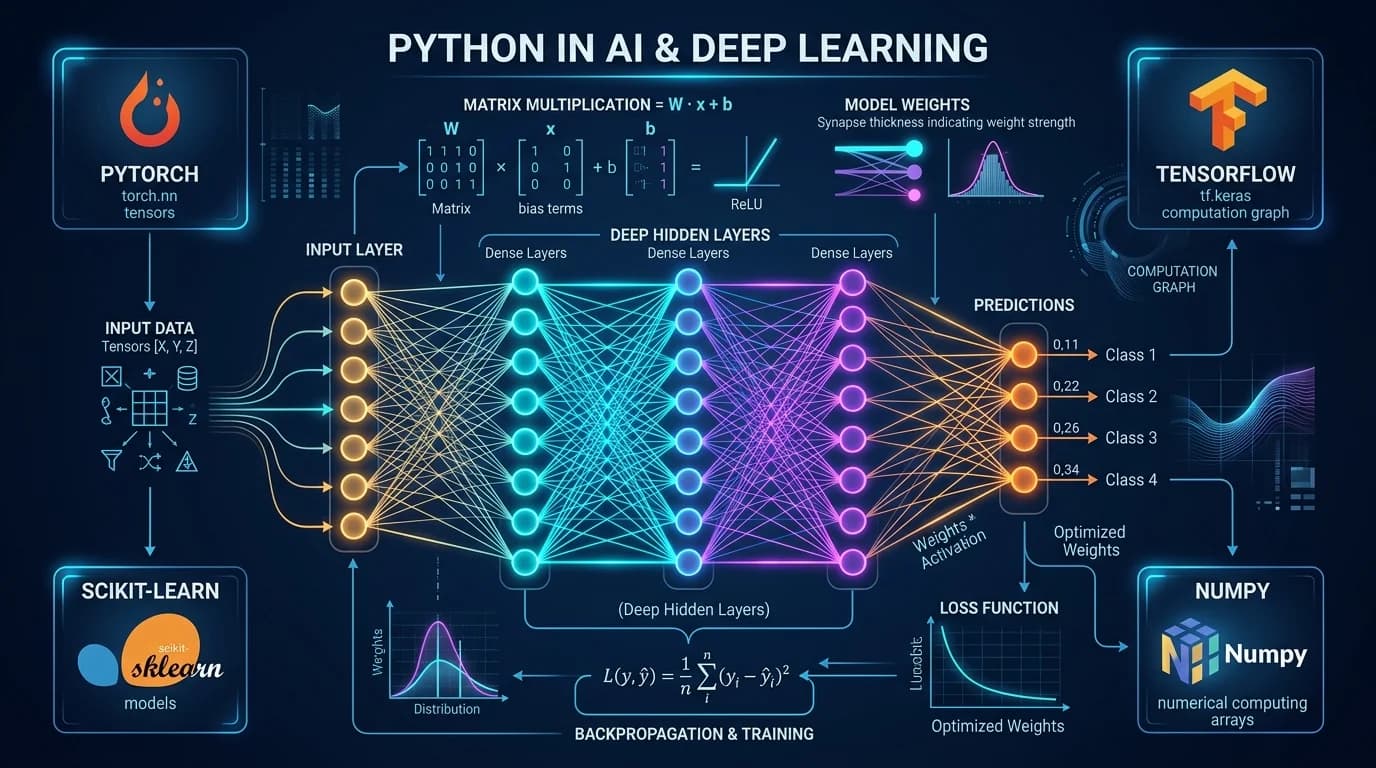
Artificial Intelligence (AI) powers technologies including voice assistants, recommendation systems, autonomous vehicles, and medical diagnostic tools. Machine Learning (ML), a subset of AI, allows computers to learn from data and improve performance without explicit programming. Python supports these advancements through its straightforward syntax, robust library ecosystem, and active community.
Python provides tools for both beginners exploring AI and experienced developers building advanced models, supporting reliable, scalable, and innovative AI solutions.
Understanding Artificial Intelligence and Machine Learning
Artificial Intelligence and Machine Learning are often mentioned together, but they represent different concepts. Understanding their relationship helps explain why Python is so valuable in both fields.
What is Artificial Intelligence?
Artificial Intelligence refers to the ability of computer systems to perform tasks that typically require human intelligence. These tasks include:
- Learning from experience
- Problem-solving
- Decision-making
- Recognizing images
- Understanding language
- Planning actions
Examples of AI include:
- Virtual assistants
- Chatbots
- Autonomous vehicles
- Medical diagnosis systems
- Fraud detection platforms
- Smart recommendation engines
The goal of AI is to create systems capable of performing intelligent actions with minimal human intervention.
What is Machine Learning?
Machine Learning is a branch of AI focused on enabling computers to learn from data instead of relying on fixed instructions.
Rather than manually programming every rule, developers train ML models with historical data, allowing systems to identify patterns and make predictions or decisions. ML can be divided into several categories:
| Supervised Learning | Learns from labeled datasets |
| Unsupervised Learning | Finds hidden patterns in unlabeled data |
| Semi-supervised Learning | Uses both labeled and unlabeled data |
| Reinforcement Learning | Learns through rewards and penalties |
These methods are widely applied across industries such as healthcare, finance, and manufacturing.
Relationship Between AI and ML
Artificial Intelligence encompasses machines performing intelligent tasks, while Machine Learning is a primary technique for achieving AI.
AI can be viewed as the destination, with Machine Learning serving as one of the most effective paths to reach it.
Python supports both AI and ML by offering robust tools for data processing, statistical analysis, visualization, and model development.
Why Python Became the Leading AI Programming Language
Several programming languages, such as Java, C++, R, and Julia, are used for AI development. However, Python remains the most popular choice among developers, researchers, and organizations.
Simple and Readable Syntax
Python is designed for readability. Its clear syntax, similar to everyday English, makes it easy to learn and maintain.
For example:
for number in range(5):
print(number)
Even beginners can understand this code with minimal explanation.
This simplicity enables AI engineers to focus on developing intelligent algorithms rather than managing complex programming syntax.
Rapid Development
AI model development often requires frequent experimentation.
Python enables developers to:
- Build prototypes quickly
- Test multiple algorithms
- Debug efficiently
- Iterate faster
This rapid development cycle is particularly valuable in research environments where ideas evolve quickly.
Open-Source Ecosystem
Python is fully open source.
This provides several benefits:
- Free to use
- Regular updates
- Continuous improvements
- Thousands of community-built packages
- Extensive documentation
Organizations of all sizes can use Python without concern for licensing costs.
Massive Developer Community
Python has one of the largest programming communities worldwide.
This means developers have access to:
- Tutorials
- Documentation
- Forums
- Sample projects
- GitHub repositories
- Online courses
- Community support
A large community also ensures continuous updates and improvements to libraries.
Features That Make Python Ideal for AI
Python has several characteristics that align well with the requirements of Artificial Intelligence and Machine Learning.
1. Easy Learning Curve
Python is more beginner-friendly than many other programming languages.
Students can focus on learning AI concepts instead of spending months mastering complex programming syntax.
This has made Python the preferred language in universities and online AI courses worldwide.
2. Rich Library Ecosystem
Python's extensive collection of specialized libraries is one of its greatest strengths.
Developers can use well-tested libraries to simplify complex tasks instead of building algorithms from scratch, such as:
- Data analysis
- Neural network development
- Computer vision
- Natural language processing
- Statistical modeling
- Data visualization
These libraries reduce development time and improve reliability.
3. Cross-Platform Compatibility
Python runs on:
- Windows
- Linux
- macOS
- Cloud platforms
- Embedded systems
This flexibility enables developers to deploy AI applications across different environments with minimal modifications.
4. Scalability
Python integrates easily with high-performance languages such as C and C++.
When computational performance is critical, developers can combine Python's ease of use with lower-level languages for optimized execution.
5. Integration with Modern Technologies
Python works effectively alongside:
- Cloud computing platforms
- Big data frameworks
- Internet of Things (IoT) devices
- Robotics systems
- Web applications
- APIs
- Databases
This makes Python an excellent choice for building end-to-end AI solutions.
Popular Python Libraries for Artificial Intelligence and Machine Learning
Python's extensive library ecosystem is a key reason for its importance in Artificial Intelligence and Machine Learning. These libraries simplify complex tasks, enabling developers to focus on problem-solving rather than building algorithms from scratch.
NumPy
NumPy forms the foundation of scientific computing in Python.
It provides support for:
- Multi-dimensional arrays
- Matrix operations
- Linear algebra
- Random number generation
- Mathematical functions
Most AI and ML libraries rely on NumPy, as efficient numerical computation is essential for training machine learning models.
Pandas
Pandas is widely used for data manipulation and analysis in Python.
With Pandas, developers can:
- Clean messy datasets
- Filter records
- Merge multiple datasets
- Handle missing values
- Perform statistical analysis
Since data preparation often consumes a significant portion of an AI project's timeline, Pandas plays a crucial role in streamlining the workflow.
Matplotlib
Data visualization is essential in AI and Machine Learning, helping developers understand trends, identify patterns, and evaluate model performance. Matplotlib is one of Python's most widely used visualization libraries.
Its capabilities include:
- Creating line, bar, scatter, and pie charts
- Visualizing training and validation accuracy
- Displaying confusion matrices
- Plotting statistical distributions
- Customizing charts for reports and presentations
Matplotlib converts complex numerical data into clear visuals, making it easier to communicate insights and improve machine learning models.
Scikit-learn
Scikit-learn is one of the most popular machine learning libraries in Python, offering a wide range of algorithms and tools to simplify model development.
Some of its key features include:
- Classification algorithms
- Regression models
- Clustering techniques
- Dimensionality reduction
- Model evaluation metrics
- Data preprocessing tools
With its straightforward interface and excellent documentation, Scikit-learn is a strong choice for both beginners and professionals.
TensorFlow
Developed by Google, TensorFlow is a leading framework for deep learning and large-scale machine learning applications.
TensorFlow supports:
- Artificial neural networks
- Deep learning models
- Image recognition
- Speech recognition
- Natural language processing
- Distributed computing
TensorFlow is designed to handle complex AI workloads efficiently, making it suitable for both research and production environments.
PyTorch
Created by Meta, PyTorch is favored by AI researchers for its flexibility and ease of use.
Its advantages include:
- Dynamic computational graphs
- Faster experimentation
- GPU acceleration
- Extensive deep learning support
- Strong research community
Many leading AI research papers use PyTorch because it enables rapid prototyping and experimentation.
Real-World Applications of Python in AI and Machine Learning
Python powers numerous AI applications that impact daily life. The following industries benefit significantly from Python-based AI solutions.
Healthcare
Artificial Intelligence is transforming healthcare by improving diagnosis, treatment planning, and patient care.
Python is used to develop systems for:
- Disease prediction
- Medical image analysis
- Drug discovery
- Patient monitoring
- Personalized treatment recommendations
AI can analyze medical scans, detect abnormalities, and assist healthcare professionals in making faster, more accurate decisions.
Finance
Financial institutions rely on AI for automation and decision-making.
Python helps build applications for:
- Fraud detection
- Credit scoring
- Risk analysis
- Algorithmic trading
- Customer service chatbots
Machine learning models process millions of transactions to identify suspicious activities in real time.
Education
Educational institutions are increasingly using AI-powered tools to personalize learning experiences.
Python supports applications such as:
- Intelligent tutoring systems
- Automated grading
- Adaptive learning platforms
- Language learning assistants
- Student performance prediction
These technologies help educators deliver more effective and individualized instruction.
Manufacturing
Manufacturers use Python-based AI systems to improve efficiency and reduce costs.
Applications include:
- Predictive maintenance
- Quality inspection
- Robotics
- Production forecasting
- Supply chain optimization
AI systems analyze equipment data to predict failures before they occur, minimizing downtime.
Transportation
The transportation industry uses AI to enhance safety and efficiency.
Python contributes to:
- Self-driving vehicles
- Traffic prediction
- Route optimization
- Fleet management
- Navigation systems
Machine learning algorithms process data from sensors, cameras, and GPS systems to support autonomous driving technologies.
Cybersecurity
Cybersecurity professionals use Python to develop intelligent systems for protecting networks and data.
Common applications include:
- Malware detection
- Intrusion detection
- Threat intelligence
- Spam filtering
- Network monitoring
AI enables security systems to identify suspicious behavior and respond to threats more quickly than traditional methods.
Python in Deep Learning
Deep Learning is a specialized area of Machine Learning that uses multi-layered artificial neural networks to solve complex problems.
Python is the preferred language for deep learning due to its rich ecosystem and powerful frameworks.
Common deep learning applications include:
- Facial recognition
- Speech recognition
- Language translation
- Medical diagnosis
- Autonomous vehicles
- Recommendation systems
Frameworks such as TensorFlow and PyTorch enable developers to build sophisticated neural networks without manually implementing every mathematical operation.
Python for Natural Language Processing (NLP)
Natural LanNatural Language Processing allows computers to understand, interpret, and generate human language. Provides libraries such as NLTK and spaCy, as well as integrations with modern transformer-based models, to simplify NLP tasks.
Examples of NLP applications include:
- Chatbots
- Virtual assistants
- Email spam detection
- Language translation
- Text summarization
- Sentiment analysis
Businesses use NLP to improve customer service, automate support, and gain insights from large volumes of text data.
Python in Computer Vision
Computer Vision enables machines to interpret and analyze visual information from images and videos.
Python is widely used in computer vision due to libraries such as OpenCV.
Applications include:
- Face recognition
- Object detection
- Medical imaging
- Industrial quality control
- Security surveillance
- Augmented reality
Computer vision continues to grow as AI technologies become more accurate and accessible.
Advantages of Python Over Other Programming Languages
While languages such as Java, C++, R, and Julia have strengths, Python offers several unique advantages for AI development.
| Easy to Learn | ✔ | Often More Complex |
| Large AI Library Ecosystem | ✔ | Limited in Comparison |
| Strong Community Support | ✔ | Varies |
| Rapid Prototyping | ✔ | Usually Slower |
| Cross-Platform Support | ✔ | Yes |
| Open Source | ✔ | Varies |
These advantages have contributed to Python's widespread adoption in academia, research, and industry.
Challenges and Limitations
Despite its strengths, Python has some limitations.
Some challenges include:
- Slower execution speed compared to compiled languages like C++
- Higher memory consumption
- Global Interpreter Lock (GIL), which can limit certain types of multithreaded performance
- Less suitable for some real-time, low-latency systems
However, these drawbacks are often offset by Python's ease of use, extensive ecosystem, and integration with optimized libraries in lower-level languages.
Career Opportunities
The increasing demand for AI and Machine Learning has created significant career opportunities for Python developers.
Popular roles include:
- AI Engineer
- Machine Learning Engineer
- Data Scientist
- Data Analyst
- Robotics Engineer
- Computer Vision Engineer
- NLP Engineer
- Research Scientist
- AI Software Developer
Professionals with strong Python skills are in demand across industries including healthcare, finance, technology, education, manufacturing, and cybersecurity.
Best Practices for Learning Python for AI
To build a career in Artificial Intelligence and Machine Learning, consider these best practices:
- Learn Python fundamentals, including variables, functions, loops, and object-oriented programming.
- Study mathematics relevant to AI, such as linear algebra, probability, and statistics.
- Practice data analysis with NumPy and Pandas.
- Learn machine learning concepts using Scikit-learn.
- Explore deep learning frameworks like TensorFlow and PyTorch.
- Build practical projects, such as recommendation systems or image classifiers.
- Participate in coding challenges and open-source projects.
- Stay updated with advancements in AI through research papers, online courses, and developer communities.
Hands-on experience is one of the most effective ways to strengthen your skills and build a portfolio.
Frequently Asked Questions (FAQs)
1. Why is Python the most popular language for AI?
Python's simple syntax, powerful libraries, excellent documentation, and large community make AI development faster and more accessible.
2. Can beginners learn AI with Python?
Yes. Python's readability and extensive learning resources make it an excellent starting point for beginners in AI and Machine Learning.
3. Which Python libraries are essential for Machine Learning?
Key libraries include NumPy, Pandas, Matplotlib, Scikit-learn, TensorFlow, and PyTorch.
4. Is Python suitable for deep learning?
Absolutely. TensorFlow and PyTorch, two leading deep learning frameworks, are built around Python.
5. What industries use Python for AI?
Industries such as healthcare, finance, education, manufacturing, transportation, cybersecurity, retail, and entertainment use Python-based AI solutions.
6. Do I need advanced mathematics to learn AI with Python?
A basic understanding of algebra, probability, statistics, and linear algebra is helpful. As you advance, a deeper mathematical foundation becomes increasingly valuable.
Conclusion
Python's importance in Artificial Intelligence and Machine Learning is significant. Its clean syntax, open-source nature, extensive library ecosystem, and active global community have established it as the leading programming language for intelligent systems. From powering recommendation engines and autonomous vehicles to enabling breakthroughs in healthcare and cybersecurity, Python offers the flexibility and tools needed to turn ideas into real-world AI solutions. As Artificial Intelligence continues to reshape industries and everyday life, proficiency in Python offers a strong foundation for innovation and career growth. Whether you are a student taking your first programming course, a researcher exploring advanced algorithms, or a professional building enterprise-scale AI applications, learning Python is a valuable investment in the future. By mastering its core concepts and leveraging its rich ecosystem, you can contribute to the next generation of intelligent technologies.
External Reference: Explore the official Python documentation and learning resources at https://www.python.org/. For machine learning tutorials and examples, the documentation at https://scikit-learn.org/ is another excellent resource.