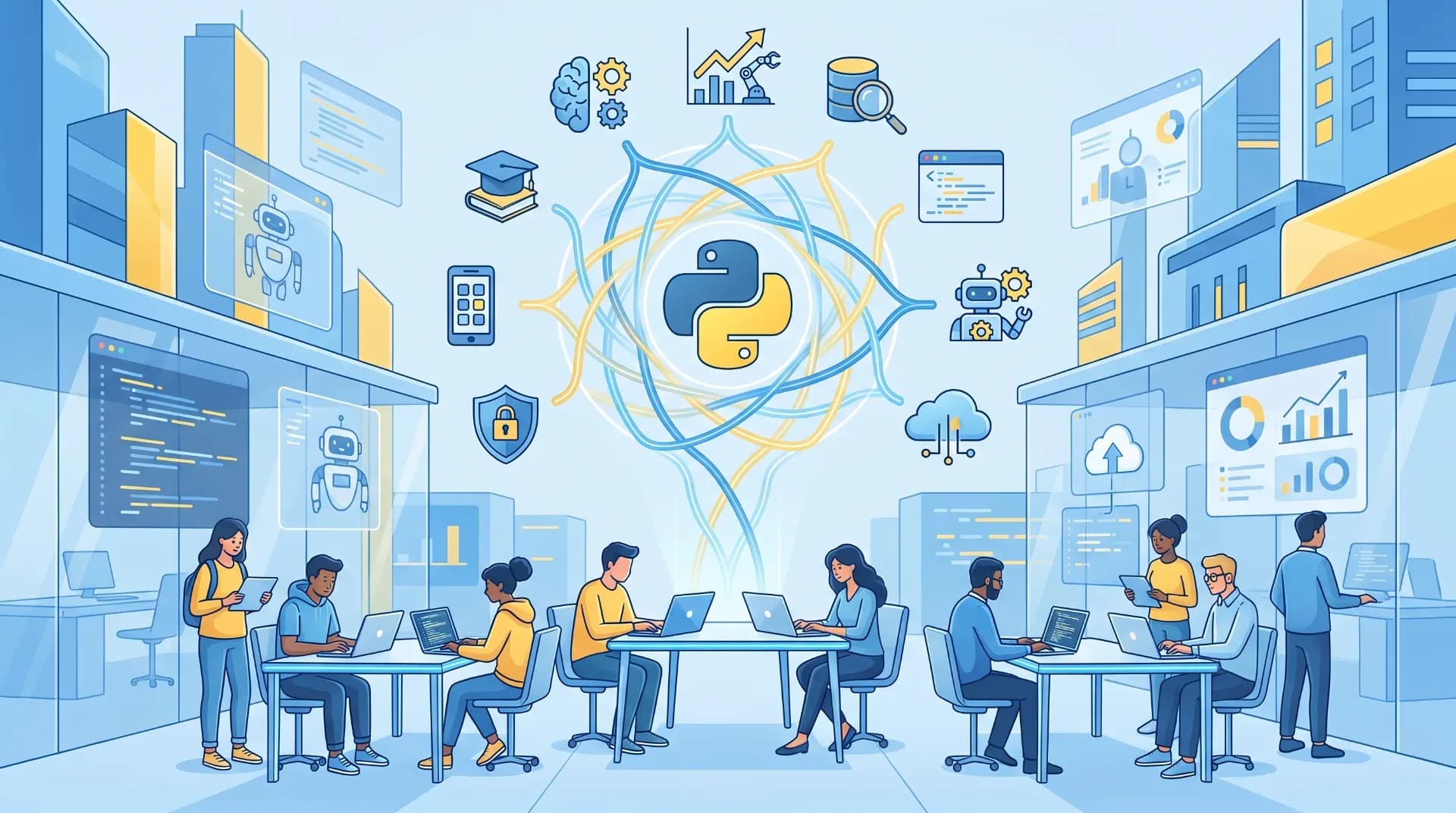
Why Python Remains the Most Valuable Programming Language to Learn
Even though technology is constantly changing, Python has still managed to distinguish itself as one of the most useful programming languages for both beginners and professionals, as well as for educators and businesses. Although a number of programming languages have become more popular in recent years, Python has kept its position among the best options for use in software development, artificial intelligence, data science, and automation.
Because of its simplicity, flexibility, and the size of its ecosystem, Python is useful to both people who are writing their first program and to experienced engineers who are developing large-scale applications. If your aim is to launch a programming career, to automate routine tasks, to analyze data, or to create applications powered by AI, Python offers a solid base.
The guide sets out the reasons why Python remains one of the best programming languages to learn and the way in which it can assist with both personal and professional development.
What Makes Python Different?
Python was created with a focus on readability and simplicity; rather than using a complicated syntax, it stresses the writing of clean and understandable code.
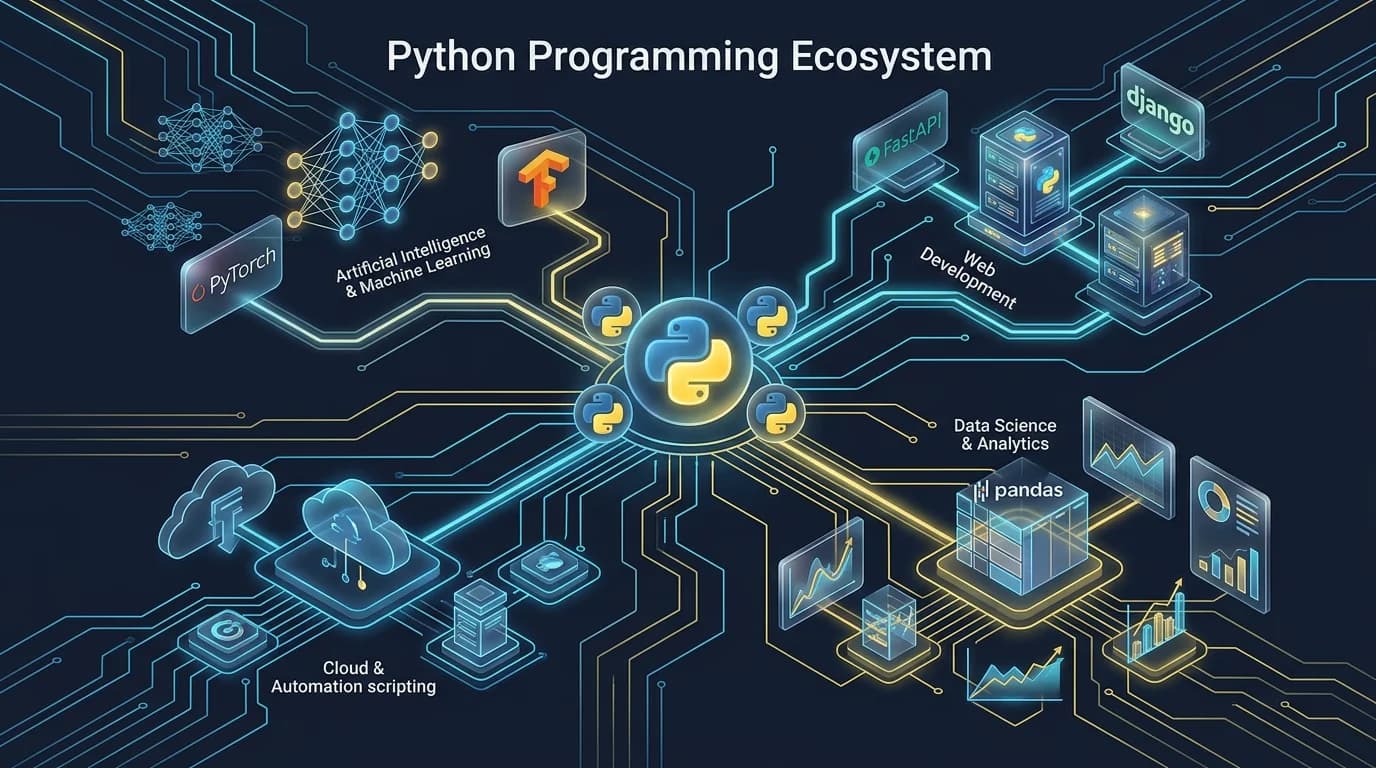
Some of Python's defining characteristics include:
- Easy-to-read syntax
- Cross-platform compatibility
- Large standard library
- Open-source development
- Strong community support
- Excellent documentation
- Compatibility with numerous third-party libraries
Since Python enables developers to concentrate more on solving problems rather than on mastering complicated syntax, it simplifies the learning process for beginners and at the same time boosts productivity among experienced developers.
Python Is One of the Easiest Programming Languages for Beginners
A great strength of Python is the fact that it is accessible.
Python differs from lower-level programming languages, which demand a great deal of attention to syntax and memory management, in that it enables beginners to concentrate on programming concepts.
For example, printing a message is as simple as:
print("Hello, World!")
Because of its straightforward nature, Python is frequently chosen for use in schools, by universities, in coding bootcamps, and on online learning platforms.
Within just a few hours students will be able to produce useful programs rather than having to spend days learning complicated language rules.
Python Powers Artificial Intelligence and Machine Learning
Python has played a major role in the development of artificial intelligence, which has transformed numerous industries.
Python is used in many AI frameworks because of its readability, the availability of a wide range of scientific libraries, and the fact that it has an active community of developers.
Python is commonly used for:
- Machine learning
- Deep learning
- Natural language processing
- Computer vision
- Recommendation systems
- Predictive analytics
- Chatbots
- Generative AI applications
The ecosystem enables developers to carry out quick experiments, which is why Python is widely used in both research and production environments.
Python Dominates Data Science and Analytics
More and more organizations are using data to make informed decisions, and Python has now become one of the main languages used in data analysis.
Common data science tasks include:
- Data cleaning
- Visualization
- Statistical analysis
- Forecasting
- Business intelligence
- Dashboard creation
Python can be used in situations that involve spreadsheets, databases, APIs, and large datasets, which means it is appropriate for analysts, researchers, and scientists.
Since it has this versatility, many businesses regard Python as one of the essential skills they look for in technical positions.
Automation Saves Time
It is possible to automate a large number of repetitive computer tasks by using Python.
Examples include:
- Renaming thousands of files
- Processing spreadsheets
- Sending automated emails
- Collecting website data responsibly
- Generating reports
- Organizing folders
- Scheduling routine tasks
Python is valuable because it reduces the amount of manual work and increases productivity, even for those who are not full-time software developers.
Python is commonly used by professionals in the fields of finance, marketing, operations, education, and research in order to simplify their daily tasks.
Python for Web Development
Python is also commonly used in the creation of modern web applications.
Developers use Python to create:
- Business websites
- Content management systems
- REST APIs
- SaaS platforms
- E-commerce applications
- Educational platforms
Popular Python web frameworks allow developers to organize their projects efficiently and at the same time support scalable applications.
Many startup companies value Python since it enables teams to develop and improve their products quickly.
Python Supports Cybersecurity
Cybersecurity experts often choose Python as it makes scripting and automation easier.
Python can assist with:
- Network monitoring
- Security testing
- Log analysis
- Vulnerability assessment
- Security automation
- Malware analysis in controlled environments
Because of its flexibility it is useful to defensive security teams, researchers and system administrators.
Python in Cloud Computing and DevOps
Modern software nowadays operates in cloud environments.
Python helps engineers:
- Manage servers
- Automate deployments
- Configure cloud infrastructure
- Monitor applications
- Build deployment pipelines
- Manage containers
Since automation is at the heart of cloud computing, Python stays an important tool in DevOps workflows.
Strong Career Opportunities
Python skills are valuable across many industries, including:
- Software development
- Artificial intelligence
- Data science
- Financial technology
- Healthcare
- Education
- Scientific research
- Manufacturing
- Government
- Cloud engineering
The programming concepts gained from learning Python are transferable and thus make it easier to learn other languages later on.
Instead of restricting the kinds of careers available, Python usually acts as a doorway into a number of different technology areas.
A Massive Community Means Better Learning Resources
Python has the benefit of one of the largest programming communities in the world.
This results in:
- Thousands of tutorials
- Free educational resources
- Community forums
- Open-source projects
- Regular updates
- Extensive documentation
There is likely someone who has already recorded a solution or provided advice via the community resources if learners come across a problem.
This active ecosystem makes learning less intimidating compared to languages with smaller communities.
Python Works Across Industries
One reason Python remains valuable is its versatility.
It is used in:
| Healthcare | Medical research, analytics |
| Finance | Risk analysis, automation |
| Education | Programming education |
| Manufacturing | Process automation |
| Retail | Inventory forecasting |
| Marketing | Data analysis |
| Government | Data processing |
| Scientific Research | Simulations |
| Artificial Intelligence | Machine learning |
| Cloud Computing | Infrastructure automation |
Broad adoption across industries is something that very few programming languages have.
Python vs Other Popular Programming Languages
| Beginner Friendly | Excellent | Moderate | Challenging | Good |
| Readability | Excellent | Good | Moderate | Good |
| AI Development | Excellent | Limited | Moderate | Limited |
| Data Science | Excellent | Moderate | Limited | Limited |
| Automation | Excellent | Moderate | Moderate | Good |
| Web Development | Excellent | Excellent | Limited | Excellent |
| Community | Very Large | Very Large | Large | Very Large |
All languages have their advantages, but Python's combination of simplicity and power makes it a practical choice for a great many learners.
Why Educators Prefer Python
Students are often given Python to learn with since it allows them to concentrate on understanding programming concepts rather than having to deal with complicated syntax.
Python supports teaching:
- Variables
- Loops
- Functions
- Object-oriented programming
- Algorithms
- Data structures
- Problem solving
As students progress, they have the option of carrying on with Python in fields such as AI, robotics, data science, and automation without having to change to another language.
Python Encourages Lifelong Learning
It's not merely a matter of learning syntax since programming also involves the development of logical thinking and problem-solving skills.
Python makes experimentation easier, allowing learners to:
- Build personal projects
- Create games
- Develop websites
- Analyze datasets
- Automate daily tasks
- Explore artificial intelligence
Such experiences help to build confidence and strengthen an understanding of the fundamental programming concepts.
A Practical Learning Roadmap
If you're new to Python, a structured approach can help you make steady progress:
- Study the syntax of Python and its basic concepts.
- Do some practice on variables, loops, functions, and data structures.
- Create small projects such as calculators or to-do lists.
- Look at file handling and APIs.
- Learn object-oriented programming.
- Select a specialization such as web development, AI, data science, or automation.
- Create a portfolio consisting of various projects.
- Keep on practicing with the coding exercises and quizzes.
One of the most effective methods of reinforcing programming concepts and spotting areas needing improvement is to practice regularly.
If you want some extra practice, NeuraQuiz provides Python quizzes which are intended to help learners check their understanding of the basic and more advanced aspects of programming. You can look at a wide range of Python quizzes on neuraquiz.com in order to improve your knowledge and keep track of your progress as you are learning.
Frequently Asked Questions
Is Python still worth learning?
Yes, Python is still widely used in the fields of education, automation, artificial intelligence, data science, web development, and so on, which makes it a valuable programming language for both novice and experienced developers.
Is the language Python difficult to learn?
Python is usually regarded as one of the easiest programming languages to learn due to its clear syntax and readable code.
Can I get a programming job by learning Python?
Python is frequently required for many jobs in the fields of software, data, AI, automation, and scripting; employment opportunities generally also depend on practical experience, projects, and problem-solving skills.
Is Python suitable for use in artificial intelligence?
Yes, Python is used a great deal in the field of AI and machine learning thanks to the wide range of libraries and tools available.
How long will it take to learn Python?
The time it takes to learn depends on your objectives, your previous experience, and the amount of time you spend studying. A great many people who are starting out will be able to grasp the basic concepts within a few months if they carry on with consistent practice.
Is it advisable to study Python before learning any other programming languages?
Python is an excellent first language for many beginners since it brings in the basic programming concepts without demanding a complicated syntax.
Where can I practice Python?
In addition to building your own projects, practicing quizzes can reinforce what you've learned. NeuraQuiz (neuraquiz.com) provides Python quizzes that help learners review concepts, identify knowledge gaps, and build confidence through regular practice.
Conclusion
Python has earned its reputation as one of the most valuable programming languages because it combines simplicity with remarkable versatility. From artificial intelligence and data science to automation, web development, cybersecurity, and education, Python continues to support a wide range of real-world applications.
Its beginner-friendly syntax, active community, and extensive ecosystem make it accessible to newcomers while remaining powerful enough for professional software development. Whether you're a student taking your first steps into programming, an educator teaching computer science, or a professional looking to expand your technical skills, Python offers a strong foundation that can grow with you over time.
The key to mastering Python is consistent practice. Building projects, solving coding challenges, and testing your understanding with quizzes can help reinforce concepts and improve your problem-solving abilities. Resources like NeuraQuiz (neuraquiz.com) can complement your learning journey by offering Python quizzes that let you assess your knowledge and continue improving at your own pace.